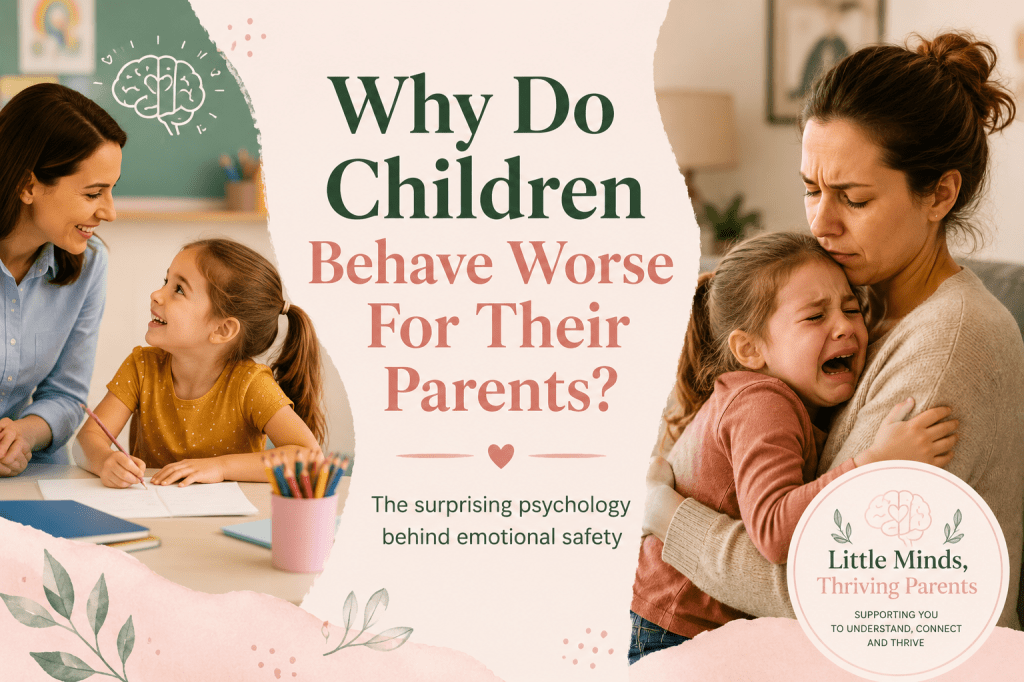
Have you ever picked your child up from school only to hear:
“They’ve had a wonderful day.”
Then within minutes of getting home, they’re arguing, shouting, crying or having a meltdown?
If so, you’re not alone.
Many parents find themselves wondering why their child seems to behave better for teachers, grandparents or other adults than they do for them.
It can feel frustrating, exhausting and sometimes even a little hurtful.
But the answer may actually be a sign of something positive.
Children Don’t Leave Their Emotions at the School Gate
Throughout the day, children are constantly managing expectations.
They may be following rules, concentrating, navigating friendships and coping with challenges.
This takes a huge amount of emotional energy.
By the time they get home, that emotional “fuel tank” can be running low.
Home is often the place where children finally feel able to release the feelings they have been holding onto all day.
The Role of Emotional Safety
One explanation comes from attachment theory.
Children develop strong emotional bonds with the people who consistently care for them.
When children feel safe and secure in these relationships, they are more likely to express their full range of emotions.
This means that the people children trust most are often the people who see them at their most dysregulated.
In other words, your child isn’t necessarily giving their worst behaviour to the person they love least.
They may be showing their biggest feelings to the person they trust most.
“After-School Restraint Collapse”
Psychologists sometimes refer to this phenomenon as after-school restraint collapse.
After spending the day working hard to manage expectations, some children simply run out of emotional resources.
The result can look like:
- Irritability
- Tantrums
- Tears
- Defiance
- Increased sensitivity
This is particularly common in younger children and children with additional needs, who may be working even harder to cope with the demands of the day.
What Can Parents Do?
Understanding why it happens doesn’t make it easy, but it can help us respond differently.
Some children benefit from:
- Time to decompress after school
- A snack and drink before tackling conversations
- Opportunities for movement and play
- Connection before correction
Sometimes what looks like “bad behaviour” is actually a child communicating that they are emotionally overwhelmed.
The Bottom Line
If your child seems to save their biggest emotions for you, it doesn’t automatically mean you’re doing something wrong.
In many cases, it means they feel safe enough to let those emotions out.
That doesn’t make the difficult moments any less challenging, but it can help us view them through a different lens.
Your child may not always show you their best behaviour.
But they are often showing you their most authentic self.
❤️


Leave a Reply