When people discover that I studied psychology, work with children, volunteer in mental health and spend much of my free time reading about child development, they often ask me the same question…
“How do you fit it all in?”
The honest answer?
Sometimes, I don’t know.
Little Minds, Thriving Parents wasn’t created because I had everything figured out.
It was created because I’m living it too.
I’m a mum to two incredible children.
My daughter, Daisy, is thoughtful, kind and wonderfully understanding. My son, Charlie, is autistic. He’s bright, funny, incredibly social and sees the world in his own unique way.
Being Charlie’s mum has taught me more than I could ever have imagined.
Like many autistic children, Charlie doesn’t always fit people’s expectations.
Until someone gets to know him, he often appears to be “coping”. He’s chatty, intelligent and sociable. People see a happy little boy.
But what they don’t always see is the effort it takes to hold everything together.
They don’t see the exhaustion after masking all day.
They don’t see the overwhelm.
They don’t see the meltdowns that happen when the pressure becomes too much.
As his mum, I sometimes felt like I had to justify his behaviour.
“Oh… he’s autistic.”
I found myself explaining, apologising and trying to help other people understand.
But over time I’ve realised something important.
Autism doesn’t define Charlie.
Charlie defines Charlie.
He’s so much more than a diagnosis.
He’s simply an amazing little boy who experiences the world differently.
One of the biggest challenges has been what many parents call being a “SENbetweener”.
Living in that space where your child has additional needs, but those needs aren’t always obvious to other people.
Sometimes, it feels like you’re constantly having to focus on the difficulties just to access the support your child needs.
You become an advocate, even when all you really want to do is celebrate who your child is.
Alongside all of this, I’m also raising Daisy.
She has different needs, different worries and different ways of understanding the world.
Parenting two children who experience life so differently has taught me that there is no such thing as a “one-size-fits-all” approach to parenting.
Sometimes I parent them completely differently.
Not because I love them differently.
But because they need different things from me.
And somehow, through all of this…
I decided to study psychology.
It actually began during the COVID lockdown.
I wanted something to keep my mind active.
What started as curiosity quickly became a passion.
I completely fell in love with understanding how our minds work.
Particularly children’s minds.
The more I learned, the more fascinated I became.
Not just by autism, but by human behaviour, child development, attachment, neuroscience and mental health.
It felt like every answer uncovered ten more questions.
So I kept learning.
I worked during the day.
Studied during the evenings.
Read journal articles after the children were in bed.
Wrote assignments during weekends.
Some nights I was exhausted.
Charlie’s sleep has never been great, so there were many days where I was running on very little sleep.
There were moments when I questioned whether I could keep going.
Whether I was giving enough to my children.
Enough to my work.
Enough to my degree.
The guilt was real.
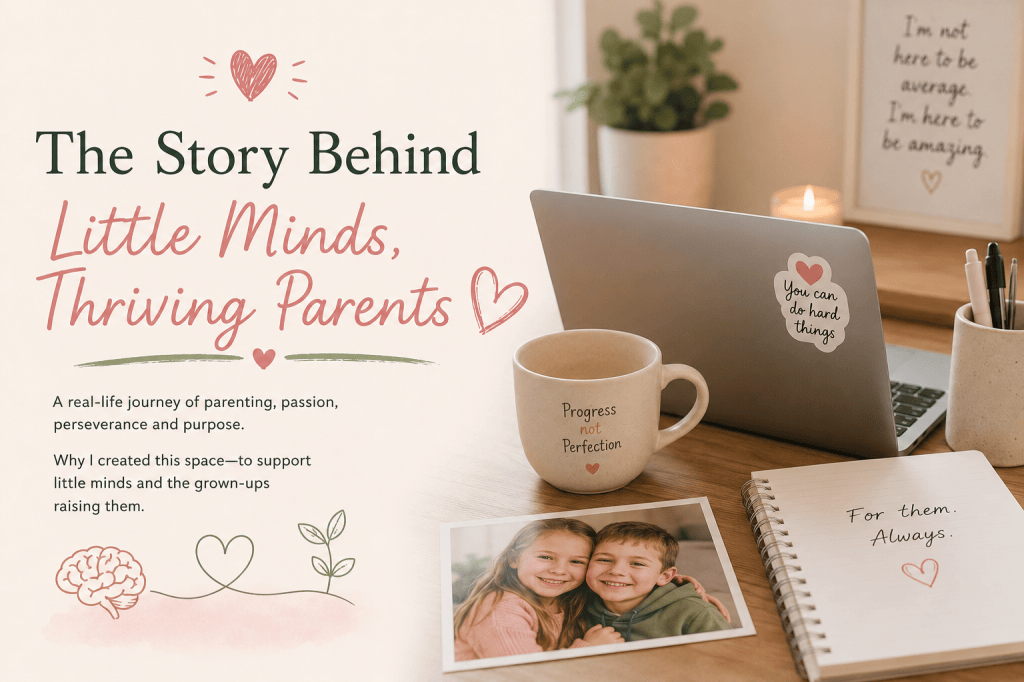
But sitting next to my laptop throughout every assignment was a photograph of Daisy and Charlie.
Whenever things felt impossible, I’d look at that picture and remember exactly why I was doing it.
Not just for me.
For them.
I wanted my children to grow up believing that if you truly want something, hard work matters.
I wanted them to see that dreams don’t happen overnight.
That it’s okay to find things difficult.
That perseverance is often more important than perfection.
I hope that one day they’ll look back and think:
“If Mum could do it, maybe I can too.”
That’s why Little Minds, Thriving Parents exists.
Not because I have all the answers.
But because I’ve learned that understanding children changes everything.
When we understand behaviour, we respond differently.
When we understand development, we worry less.
When we understand neurodiversity, we stop trying to change children and start changing how we support them.
My goal isn’t to tell parents how to raise their children.
It’s to share evidence-based psychology, neuroscience and real-life experience in a way that’s practical, honest and compassionate.
Whether you’re raising a neurotypical child, a neurodivergent child, or simply trying your best through the beautiful chaos of parenthood…
I hope you find something here that helps you feel a little more informed.
A little more understood.
And a little less alone.
Welcome to Little Minds, Thriving Parents.
I’m so glad you’re here.
❤️


Leave a Reply